
DAYTON, Ohio (AFLCMC) -- “You are part of the fight,” Lt. Gen. Jason Voorheis, commander of the Air Force Life Cycle Management Center (AFLCMC) told attendees at the Ohio Defense and Aerospace Forum earlier this week. “General Dale White [Director, Critical Major Weapon Systems at the Pentagon] is fond of saying that militaries don't go to war - nations go to war. You all are part of what our nation brings to the fight in terms of developing fielding and getting capability into the hands of our warfighters.”
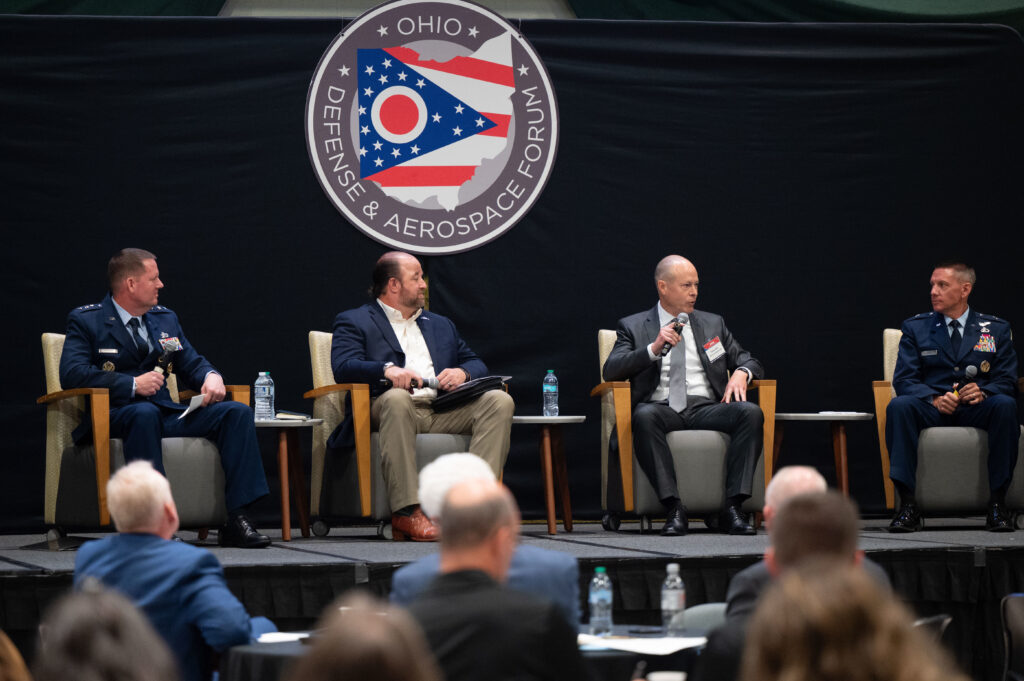
Voorheis spoke as part of a panel titled “Power Projection from the Heartland.” He was joined on stage by Brig. Gen. Timothy Helfrich, AFLCMC Portfolio Acquisition Executive (PAE) for Fighters and Advanced Aircraft, alongside defense industry professionals TK Kubit and Anthony Cain. JP Nauseef of JobsOhio moderated the discussion. The forum was hosted by the Dayton Development Coalition.
Held at Wright State University on September 21, 2026, the forum highlighted the strategic alignment between Air Force modernization priorities and the Ohio defense ecosystem.
Key panel themes:
- Acquisition Speed and Agility
- Open Architecture
- The Ohio Defense Ecosystem
- Workforce and Talent Development
- Public-Private Collaboration
In his opening remarks, Voorheis explained the Air Force acquisition workforce's shift to accept risk earlier, lean into commercial technology and open mission systems, and empower program teams to make decisions that drive projects forward.
Both Voorheis and Helfrich noted that acquisition teams at Wright-Patt and across the Center are transitioning away from platform-specific "stovepipes" to focus on broader, integrated capabilities across advanced aircraft. These teams are also balancing intensive current fleet modernization with future systems development by shifting from individual platform upgrades to an integrated, "system of systems" approach.
“I think one of the really important parts about the acquisition transformation is the change in philosophy and focus on delivering fielded capability as kind of the preeminent prioritized pacing thing that we do, and everything else is about how we achieve that to include the authorities we're giving PAEs,” noted Voorheis.
Helfrich’s Fighters and Advanced Aircraft portfolio includes the A-10, F-15, F-16, F-22, plus the FQ-42, FQ-44, other collaborative combat aircraft.
The Air Force Research Lab (AFRL) is also headquartered at Wright-Patt. Helfrich touted how AFRL led key advances in open architecture and credits AFRL with developing the Collaborative Combat Aircraft (CCA) program.
“There would be no CCA without the Air Force Research Laboratory,” explained Helfrich. “Both the FQ-42 Vengeance [and] the FQ-44 Fury were heavily invested in by AFRL. Because software is sold separately with CCA, the mission autonomy work started at AFRL. They were really the ones who put together the first consortium to build Autonomous Government Reference Architecture (A-GRA). This has become a huge program, all made possible because of the investments by AFRL.”
For both Voorheis and Helfrich, the workforce and supporting infrastructure remain top concerns. Helfrich urged educators in the audience to modernize military engineering and software development classes. Both speakers noted the shortage of physical defense infrastructure in the area around Wright-Patterson, particularly for high-level classified work.
In addition to physical plant limitations, hiring remains a challenge. AFLCMC currently has over 1,700 vacancies, with more than half located at Wright-Patt. Most open positions are in technical fields like engineering and logistics. Business areas like contracting and program management also have many openings.
“We need help recruiting from the universities and from industry as well, both defense industry and non-defense industry,” explained Voorheis. “You don't have to come in with a lot of aerospace experience. What we really need is highly talented, motivated, critical thinkers.”
The panel marked the first time Lt. Gen. Voorheis has publicly spoken about his role leading AFLCMC since assuming command late last month.